Language is the heartbeat of early education. In the Pre-Prep years, language is not only a subject but the foundation of all learning and expression. At AISL Harrow Hengqin, our approach to developing language in Pre-Prep is intentional, dynamic, under constant review, and fully integrated into every facet of the school day. As educators of second-language learners, we are conscious that our pupils often receive less English exposure outside of school hours. We therefore must utilise the school hours wisely to model high-quality English language in all that we do to provide the broad depth of vocabulary required for our pupils to broaden their languages. Every moment is a language-learning opportunity.
It will come as no surprise that a fundamental component of language development during the Pre-Prep phase is systematic phonics learning. At Harrow Hengqin, this is introduced in K2 and matures all the way to Grade 3 in order to produce solid foundations in the four key areas of English language. By delivering a phonics programme aligned with the Harrow LiDe curriculum and the UK Department for Education’s recommendations, our children are immersed in the sounds and structures of English in a way that is multisensory, consistent, and enjoyable for all.
We have seen remarkable growth in our learners’ decoding and blending skills, which has translated into more confident readers and writers. What makes our phonics provision stand out is its flexibility to support all learners, with the commitment of all classroom practitioners. Through tailored games, structured reading sessions, carefully planned resources, regular progress checks and targeted small-group close personal tutoring, every child has access to high-quality phonics instruction at their individual level.
“Children’s spoken language ability at the age of five is the single most important factor in determining their literacy and numeracy skills at age 11.”
– Save the Children
One example that stands out is a Grade 3 pupil who joined us with limited English at the start of Semester 1 this academic year. Through daily phonics in small close personal tutoring, regular storybook reading, and immersive teacher modelling of English, this pupil not only began to decode simple words within weeks but was also able to independently contribute to whole-class discussions by Semester Two. These moments reinforce the power of a consistent and supportive phonics structure in building not just language ability, but also language confidence.
One of the most limiting factors in providing rich language development opportunities in school can be the structure and organisation of the school day. Many Pre-Prep schools offer one English lesson a day. Whilst this may provide ample time for vocabulary enrichment in English first-language environments, we found that our pupils needed additional scheduled time to specifically develop reading skills. The introduction of a speedy twenty-minute reading session after lunch not only provides this additional structured time to enhance decoding and vocabulary development, but it also sets the tone for the afternoon ahead each day. These reading sessions are developed from the ‘Talk Through Stories’ programme by Ruth Miskin. This verbal, story-based approach allows students to dive deeply into one high-quality text each week, using repetition and structured discussion to build rich, meaningful vocabulary. Students are encouraged to retell the story, explore character motivations, and use new words in context, creating a bridge between quality English literature, spoken language and comprehension that supports both EAL and native English speakers alike.
To ensure that our pupils’ language development is not left to chance, we use the Global Scale of English (GSE) as a tracking tool from G1 onwards. GSE allows us to pinpoint students’ progress in speaking, listening, reading, and writing against international benchmarks, and to plan next steps with clarity and purpose. Our teachers use the GSE to set STA targets, differentiate activities, and provide students with feedback that is meaningful and actionable. For example, a recent focus on developing extended responses in speaking was tied directly to a GSE objective. We scaffolded this through talk partners, sentence stems, and visual prompts, and within weeks, we saw a measurable shift in both participation and complexity of student responses. This kind of data-informed teaching allows us to be proactive, ensuring that no learner falls behind and that progress is celebrated in a personalised way.
To reiterate, language development does not only happen during English lessons. It is woven into our wider curriculum, whether students are explaining their reasoning in maths, describing the lifecycle of a caterpillar in science, or sharing a personal story in project-based learning. Homeroom, specialist, and bilingual classroom practitioners must collaborate and work together in partnership to embed language goals across all subjects; we are all language teachers. We create shared vocabulary walls in Mandarin, model subject-specific language in Art and Music, and use sentence stems in PE to promote reflective thinking.
Recently, our Grade 2 students explored the United Nations Sustainable Development Goal of ‘Zero Hunger’, as part of their Project-Based Learning. They learned about food banks and how these organisations support the wider community. This topic provided a powerful context for developing language, as students were introduced to new subject-specific terminology such as ‘volunteer’, ‘community support’, and ‘nutrition’. They practised using this language in oral discussions, research projects and written reflections. By linking global citizenship to real-world language application, students not only developed humility but also deepened their ability to explain ideas clearly and purposefully. This broader, embedded approach ensures language is not seen as a barrier, but as a tool for connection, creativity, and critical thinking.
Developing language in a bilingual, international school setting is both a challenge and a privilege. Our approach is thoughtful, evidence-based, and, above all, child-centred. By embracing a culture where language is modelled, celebrated, and integrated, we ensure our youngest Harrovians are truly ready to communicate, critically think, and lead with confidence.
Language Learning that may be of interest:
Get a special discount by quoting code AISLMALL during CHECKOUT.
Books and E-books – Shanghai Book Traders
Shanghai Book Traders was established in 1950 and has a development history of over 70 years. It is a state-owned book import and export company with its headquarters located at Fuzhou Road, Huangpu District, Shanghai. It owns its own stores and warehousing centers and has branches overseas as well as several distribution centers in Asia, Europe and America. The company has established partnerships with thousands of publishing houses at home and abroad. Its business scope includes book retail, wholesale, import and export of books and periodicals, holding various book exhibitions at home and abroad, copyright trading, agency import and export, etc. Among them, the book import and export business holds over 70% of the market share in the East China region and has established business relations with most foreign-related schools and institutions in the region.
Language Learning – Speechsquare

Speechsquare by Melyngo Technology PTE LTD is an AI Speech Analytics company. They optimise the tutoring and assessment of oral skills. Their proprietary AI allows granular analysis of speech up to the phoneme, enabling instant visual and audio feedback for the learner and powerful analysis tools for language specialists. Speechsquare is available in 7 languages: English, Chinese, Korean, Japanese, Spanish, French, and German.
Leveled Reading Platform for Pre-K to Grade 8 – Chinese 1-2-Tree
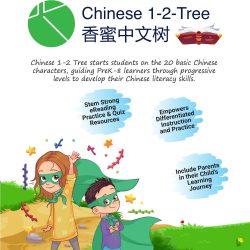
Chinese 1-2-Tree is a unique leveled reading interactive learning platform designed to provide progressive leveled reading starting with 20 basic characters. Chinese 1-2-Tree provides teachers with a scaffolded leveled reading program that uses accessible digital technology to improve teaching effectiveness, save time, and reduce students’ workload. Chinese 1-2-Tree offers literacy essentials for every PreK-8 Chinese classroom. They offer a complete solution for reading instruction and student practice, perfect for use in class and at home.
Online English Classes for Kids – Novakid
Novakid is Europe’s #1 online English school for kids aged 4-12, trusted by families worldwide. With certified native-speaking teachers, it offers interactive lessons that make learning fun and effective. Using games, activities, and full-language immersion, Novakid helps kids build confidence and English fluency. Its CEFR-based curriculum ensures real progress, while parents appreciate the blend of high-quality education and enjoyable experiences that prepare children for future success.