When I think of the greatest risks of AI to our children, institutions and communities, I don’t think about Terminator. I don’t think about a day in the future when autonomous drones or robots will overthrow their human overlords. I don’t think of the singularity.
The greatest – and often, successful – revolutions tend to be quiet. Discreet. They may seem inevitable, in hindsight, but they generally creep, slowly and often unobserved to the general public.
If you were born within the last half century or so, you’ve already seen one of the most recent creeps, whether you’ve known its proper name or not: specifically, the phenomenon that historians and technologists often call technological creep (or techno creep). This is when a technology or system expands beyond its original purposes, often acquiring new functions or features that are, simply put, overkill to achieving its end objectives (1).
Techno creep is important not because of the technology that’s involved. It’s important because of the passivity we accept it with, and what this passive acceptance says about our vulnerability and fallibility as human users.
As features, designs or capabilities of powerful machines are introduced, little by little, into our childhoods, our schools, our leisure time, our interpersonal relationships, we tend to normalise them, accept them. We forget to push back. And as others around us do the same, we all settle into a “new normal,” where we tacitly accept the status quo, because to do so is peaceful, harmonious. Why rock the boat?
Tech devices on their own are not evil. But our uncritical, unintentional absorption of them into our lives, where we allow devices to shape the meaning we make and the realities that we live, is problematic, and something parents and educators should be vigilantly aware of.
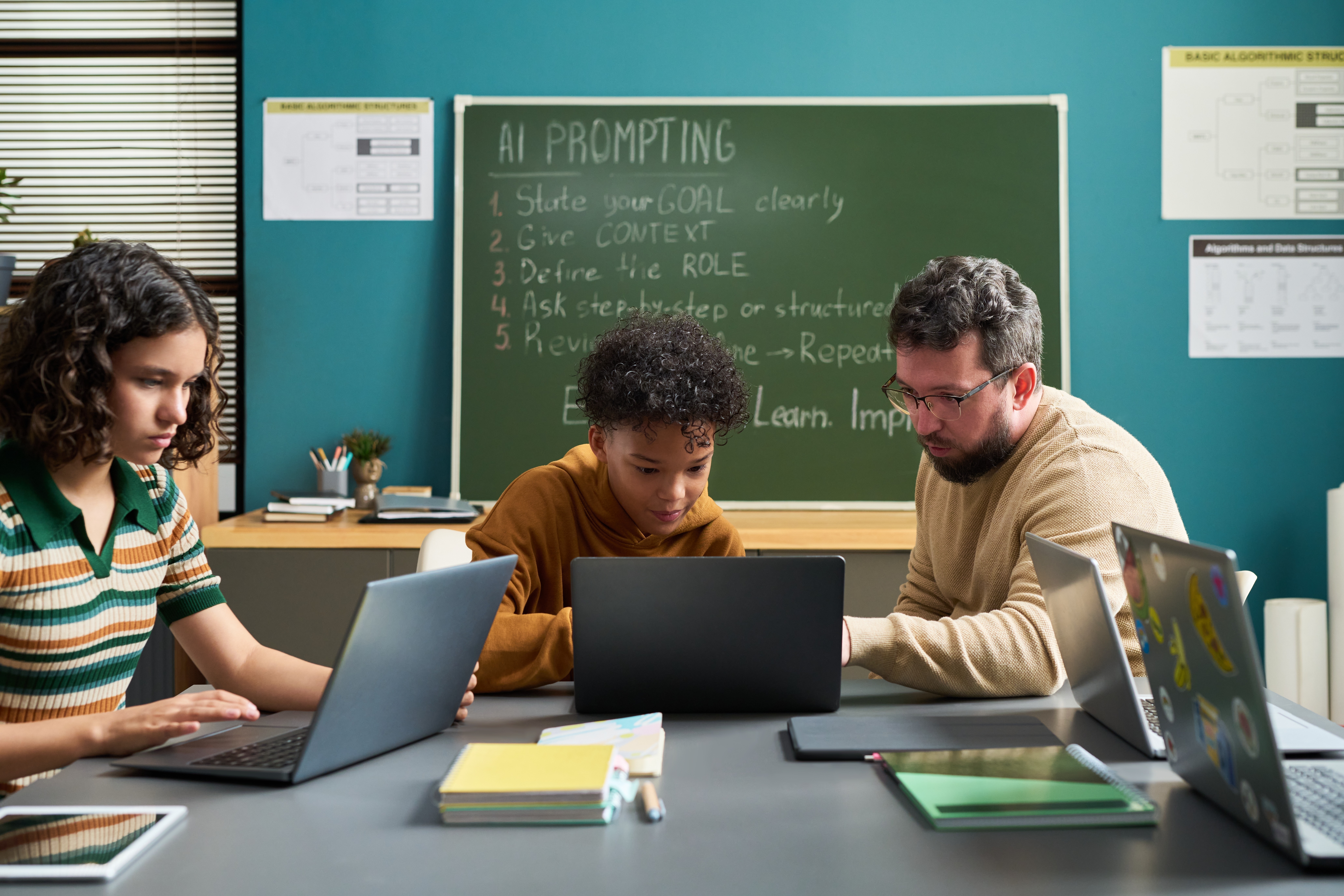
Let’s take a look at one specific kind of emerging technology, generative AI, through this lens. I recently sat down with a group of 14-year-old girls at an international school in Asia to listen to their thoughts on AI in their schoolwork. They discussed how they knew when fellow classmates overused AI in their essays, even when such misuse wasn’t flagged by the plagiarism detector. Students in schools globally know the reality better than most of the adults around them. Everyday, potentially in every assignment, our children are faced with important questions about tech creep. They are faced with the question of whether to be themselves – and therefore create friction in their learning processes by constructively struggling through an assignment without overusing AI – or to succumb to the peaceful, gentle steamrolling of their voice and thoughts by leaning heavily on AI tools. (For the record, I don’t believe AI should never be used in learning assignments. AI tools used proportionately, intentionally and within a certain context are great learning aids. But the reality we must pragmatically prepare ourselves for is that most students we interact with haven’t been equipped with the discernment to judge behind closed doors the very thin line between AI use that is proportionate and AI use that is overkill.)
This isn’t only an issue of “upskilling” our students in AI. It’s an issue of character and the messages we send students beginning from early childhood about how friction and constructive struggle within oneself is a green light for self-development and growth. We must send the message to our students, from a younger and younger age (I recommend beginning this sort of human intelligence training through your existing SEL and sensory play curriculum from early childhood), that to be imperfect is not only okay, it’s desirable. We must allow them to develop their own voices and applaud their imperfections so that they learn to be proud of their uniqueness. We must challenge ourselves as parents and educators to look further than the academic grade, and to think about the long-term risks of being overly polished, overly standardised, and utterly forgettable.
As E.E. Cummings famously said, “The hardest challenge is to be yourself in a world where everyone is trying to make you be somebody else.” The Siren’s pull of generative AI to learners around the world has made this quip ever more true.
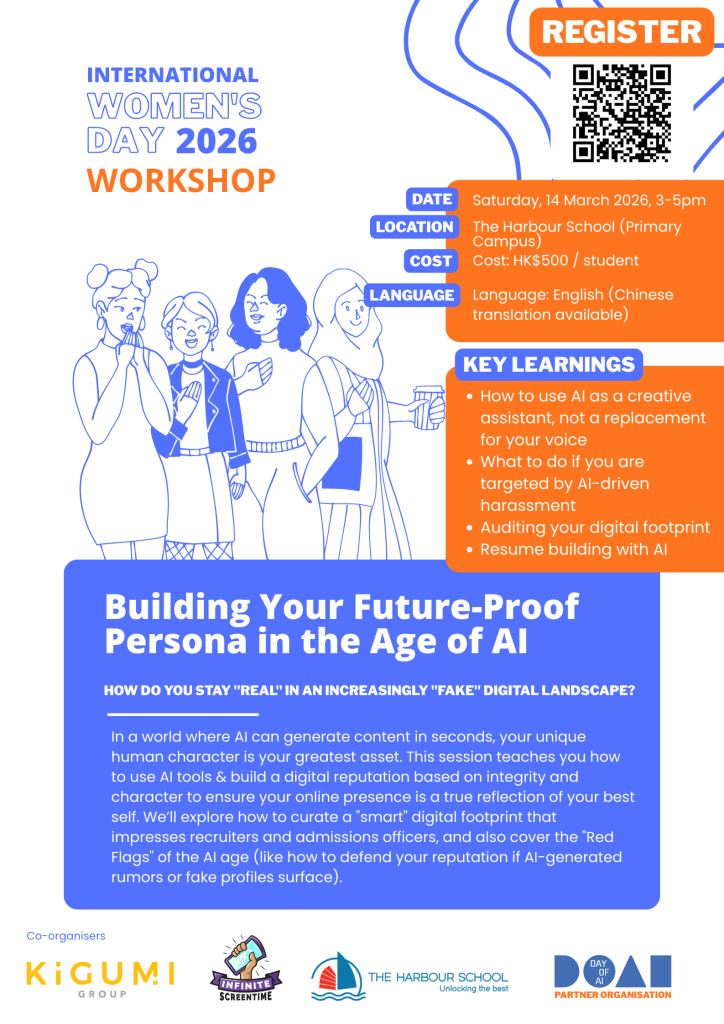
Mila is the Founder and Chief Education Officer of Kigumi Group, a Hong Kong-based digital wellbeing company, and will be running a workshop for teen girls and AI at The Harbour School in celebration of International Women’s Day 2026.
This piece is a contributed article shared by the author as part of our expert content series. Mila is the Founder of Kigumi Group and a certified AI ethics assessor by the Institute of Electrical and Electronics Engineers (IEEE).
References: Koops, B. J. (2021). The concept of function creep. Law, Innovation and Technology, 13(1), 29–56. https://doi.org/10.1080/17579961.2021.1898299. Accessible at https://www.tandfonline.com/doi/full/10.1080/17579961.2021.1898299