Across international and national systems, there is growing awareness that student wellbeing, identity, and academic success are closely tied to how their languages and cultures are acknowledged and valued in school life. Decades of research reinforce the cognitive, social, and academic benefits of bilingualism and cultural affirmation. Yet despite this, many educators around the world still have not learned about this research, nor have they developed what we call the BML knowledgebase.
The BML knowledgebase is an essential foundation of knowledge and strategies that support bilingual and multilingual learners in the classroom and beyond. This knowledgebase must be explicitly learned by educators because much of the information is not common knowledge. In fact, there are many myths that have become accepted by professionals and educators alike, and these myths can do a great deal of harm to BMLs and their families.
For example, when parents are told to switch to English (or the dominant language) at home to help their child become more successful at school, this can actually cause the home or family languages to dissolve. The consequence of this can mean that students will enter school as bimultilinguals but then graduate secondary school as monolingual. Many would have lost deep connections to their cultural group and family members because they cannot communicate comfortably with them. These are issues that many professionals are not aware of especially if they themselves are not bilingual or multilingual.
This is why we need all schools and educators to not only understand the value of inclusive practises for BMLs, but to implement them school-wide. Many English-medium schools mistakenly believe that professional development for staff or leadership on BMLs is unnecessary, assuming that such training is only relevant in bilingual settings rather than where English is the sole language of instruction.
This highlights a fundamental misunderstanding of the journey BMLs experience in these schools. Educating BMLs in English-only does not eliminate the need for targeted support. In fact, it makes it even more critical. The belief that full English immersion is sufficient often signals a lack of awareness about the cognitive, linguistic, and emotional challenges BMLs face as they navigate learning in a language that may not yet feel natural or accessible to them.
While schools may proudly display flags in their lobbies, host international food festivals, or translate newsletters, all positive and well-meaning steps, these actions often remain symbolic. They rarely transform daily classroom experiences or address deeper systemic issues related to BMLs thriving. The real challenge is moving from surface-level gestures to sustainable, whole-school change that supports BMLs at every level.
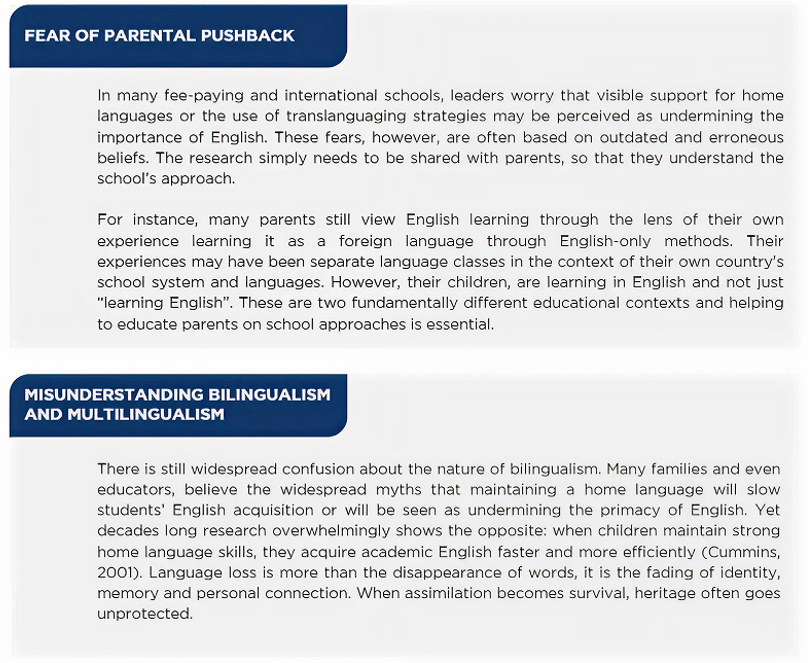
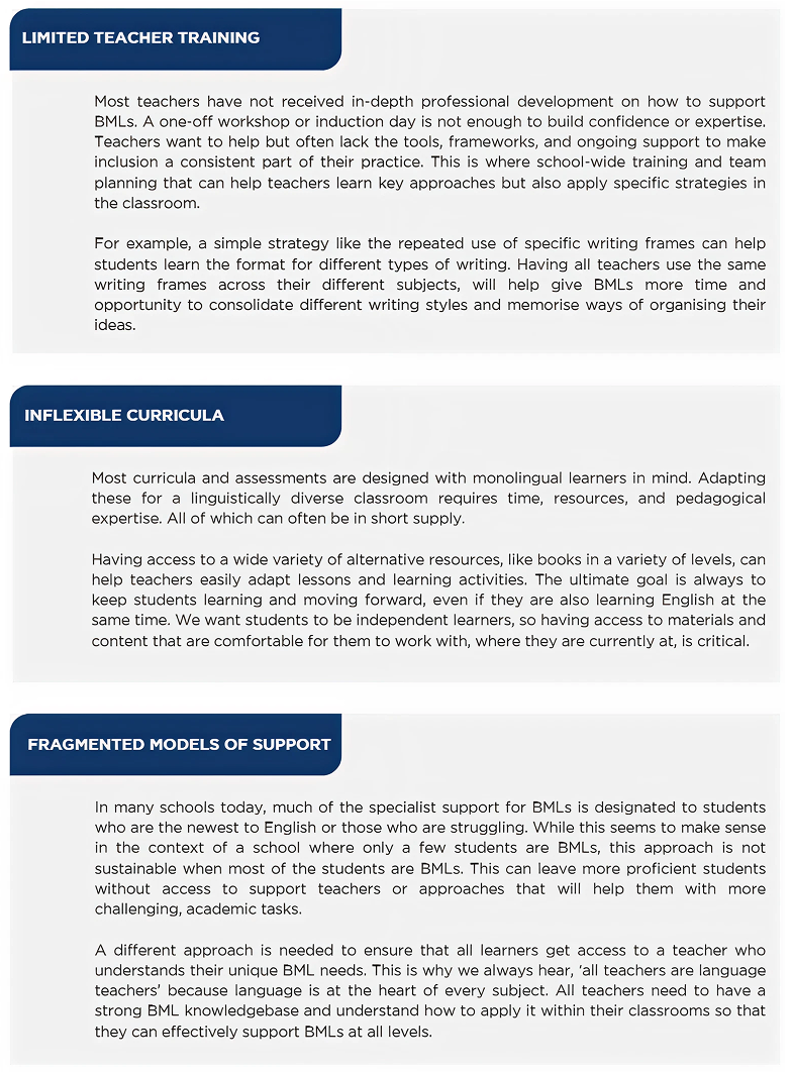
Having worked closely with schools in their training inclusion practises, I have had the opportunity to see educators’ strong desire to improve their educational philosophies and practices. But I have also identified several barriers that can hinder their progress. In many cases, there are simple changes that can make a world of difference, but understanding and moving beyond obstacles is essential.
Here are five key challenges that often hinder schools from making deep, meaningful change and potential solutions.
However, when we asked students about their parents’ languages and what languages were spoken at home, we found that most of the students in the school were actually BMLs, but the school records often indicated that English was the language spoken at home. Parents did not share the information about their other languages, perhaps because they felt it might be a deterrent to their child’s school admission.
This proved to be an easy fix with some changes to the admission forms and training for the admissions staff. Having them understand how to gently pull more information about family languages while giving positive affirmations when families mentioned their bilingual or multilingual background was very effective. This also ensured that the leaders and educators truly understood who their students were and could design more appropriate initiatives, supports and learning experiences for their specific student population.
Schools that want to deepen inclusion practices do need to make specific, actionable changes that can take them out of their comfort zones. These changes can not only help BMLs thrive in the school and classroom; but they can even help learners maintain their languages and connections to both family and culture.
While adopting inclusive approaches can challenge the way things have always been done, positive results can often be seen quickly.
“The first time I tried translanguaging with my students, it felt very uncomfortable because I didn’t know what they were saying, but when I saw how happy they were and how productive their learning was, I was convinced.”
– Ella, Year 6
Genuine linguistic and cultural inclusion goes far beyond surface-level gestures. It requires leadership, system-wide coordination, professional expertise, and most of all commitment to equity. Schools that invest in this deeper work not only improve outcomes for their bilingual and multilingual learners but create richer learning environments for everyone. Granted, this journey is not easy, but it is essential. And in a world that is increasingly multilingual and multicultural, that’s not just a nice-to-have, it is a necessity. And the schools that embrace it will stand at the forefront of educational excellence in a multilingual world.
Francesca McGeary is the Director of the Centre for Educators of Bilingual & Multilingual Learners in the UK. She works closely with schools and educators, helping them to build their BML knowledgebase and develop inclusive policies and practises.
Language Learning that may be of interest:
Get a special discount by quoting code AISLMALL during CHECKOUT.
Books and E-books – Shanghai Book Traders
Shanghai Book Traders was established in 1950 and has a development history of over 70 years. It is a state-owned book import and export company with its headquarters located at Fuzhou Road, Huangpu District, Shanghai. It owns its own stores and warehousing centers and has branches overseas as well as several distribution centers in Asia, Europe and America. The company has established partnerships with thousands of publishing houses at home and abroad. Its business scope includes book retail, wholesale, import and export of books and periodicals, holding various book exhibitions at home and abroad, copyright trading, agency import and export, etc. Among them, the book import and export business holds over 70% of the market share in the East China region and has established business relations with most foreign-related schools and institutions in the region.
Language Learning – Speechsquare

Speechsquare by Melyngo Technology PTE LTD is an AI Speech Analytics company. They optimise the tutoring and assessment of oral skills. Their proprietary AI allows granular analysis of speech up to the phoneme, enabling instant visual and audio feedback for the learner and powerful analysis tools for language specialists. Speechsquare is available in 7 languages: English, Chinese, Korean, Japanese, Spanish, French, and German.
Leveled Reading Platform for Pre-K to Grade 8 – Chinese 1-2-Tree
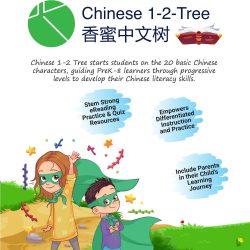
Chinese 1-2-Tree is a unique leveled reading interactive learning platform designed to provide progressive leveled reading starting with 20 basic characters. Chinese 1-2-Tree provides teachers with a scaffolded leveled reading program that uses accessible digital technology to improve teaching effectiveness, save time, and reduce students’ workload. Chinese 1-2-Tree offers literacy essentials for every PreK-8 Chinese classroom. They offer a complete solution for reading instruction and student practice, perfect for use in class and at home.
Online English Classes for Kids – Novakid
Novakid is Europe’s #1 online English school for kids aged 4-12, trusted by families worldwide. With certified native-speaking teachers, it offers interactive lessons that make learning fun and effective. Using games, activities, and full-language immersion, Novakid helps kids build confidence and English fluency. Its CEFR-based curriculum ensures real progress, while parents appreciate the blend of high-quality education and enjoyable experiences that prepare children for future success.