Until the latest revision to the COBIS Accreditation and Compliance Standards launched in January 2025 there was an expectation that “The school teaches the majority of subjects through the medium of English.” Within the Accreditation team here at COBIS we have supported a number of schools working towards COBIS Accreditation in recent years where that wasn’t always the case where a bilingual approach to learning and teaching had been deliberately adopted.
As the Council of British International Schools English language learning is still central to the COBIS Standards but we have adapted to make a subtle amendment that “the majority of subjects are taught in English (or in parity of English with an additional language if in a bilingual school context).” This may seem like a very minor change, but it serves to recognise and to validate the work that an increasing number of schools, especially, but not exclusively, in China are undertaking to develop students’ ability to learn bilingually.
There is an increasing body of research into why and where this is taking place how effectively it is being implemented and both the degree of bilingual mastery and motivation of students learning in these schools. There are links to some of this research at the end. In this short article the intention is to share the COBIS experience of working with such schools to give insight into their motivation successes and challenges specifically through the lens of COBIS Accreditation. These schools are either international or bilingual and generally operate as whole schools for students from as young as 2–3 to 18 years old.
In China where most of our work with such bilingual international schools has taken place part of the move towards bilingual learning has been a result of national policy requirements around learning and teaching in Chinese at least alongside English during the compulsory school years. These schools are adapting to evolving market conditions with growing demand from local families seeking internationally influenced curricula within their national framework and ecognizing the value of dual language bilingual learning.
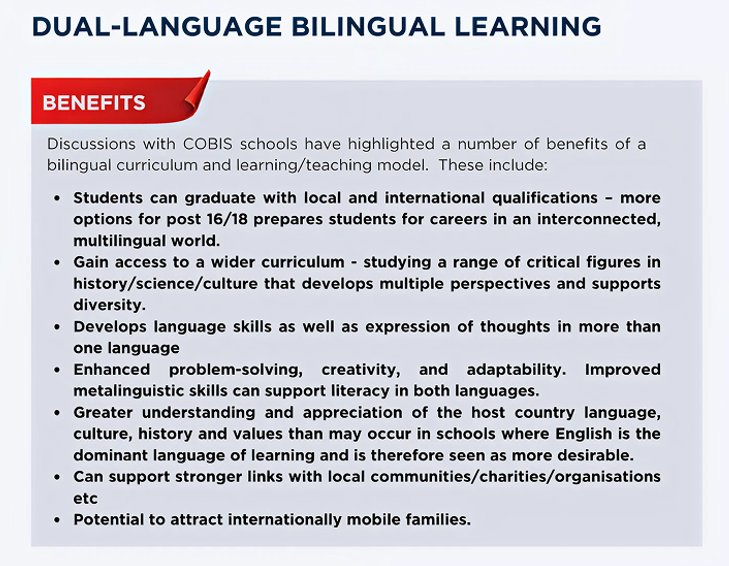
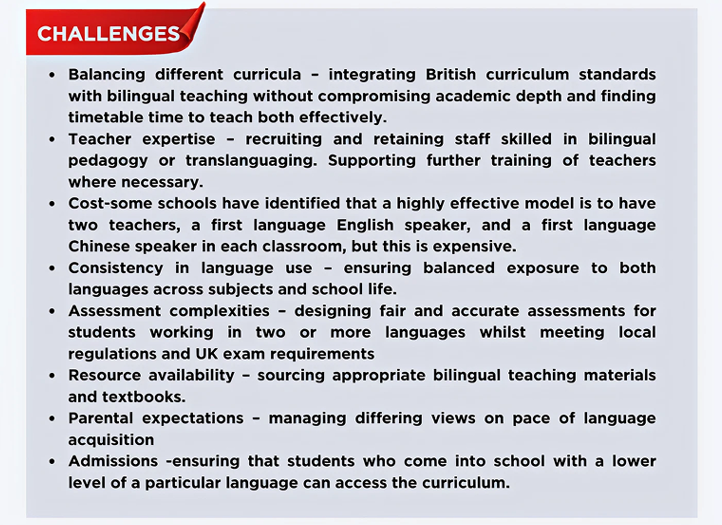
At COBIS we are fortunate to work with high-quality educators around the world, some of whom support us in our accreditation processes with other schools, either joining visiting teams as Peer Accreditors, or leading a whole process as a COBIS Lead Improvement Partner (LIP). Oliver Wells is Headmaster at AISL Harrow Haikou, China, a member of the AISL group of schools, he is a COBIS LIP and has taken part in or led multiple COBIS team visits in China. As a headteacher in a bilingual school and a parent of bilingual children, he has a keen interest in the success of bilingual education. He shares his thoughts below.
At its heart, bilingualism allows children to understand the world from a broader perspective. One of my favourite aspects is seeing how children notice the subtle impact language has on communication, how a turn of phrase in one language might seem blunt when translated into another, or how humour can emerge from playful juxtaposition across languages. These moments show not only linguistic skill, but also cultural agility.
For example: “How do you start a bilingual running race? One, two, three… woof!” In English, we say “one, two, three, go!”, but in Mandarin, the word for “dog” is gǒu (狗), which sounds almost exactly like the English word go. A bilingual listener automatically hears both meanings at once. In the punchline, the English meaning “start running” is suddenly replaced by the Chinese meaning “dog”, and the brain makes the unexpected leap to a barking sound woof! This humour is something bilingual speakers are uniquely attuned to.
More practically, it is clear that English is the lingua franca of international business, academics, sport and international relations and English fluency gives students access to a wealth of opportunities. However, research shows that children learn a second language more effectively with a strong foundation in their mother tongue. Many national curricula have significant strengths, whether in maths, sciences, or cultural education. Bilingual schools allow students to benefit from these while developing their English to an advanced level.
Recruiting and retaining high-quality staff who can work comfortably and effectively in bilingual environments requires careful planning. Curriculum alignment between national and international standards is complex and expectations from parents, some seeking a more traditional approach, others prioritising international exposure, must be balanced. Success in bilingual education depends on maintaining academic rigour in both languages while nurturing a shared school culture that unites students, staff and the wider community.
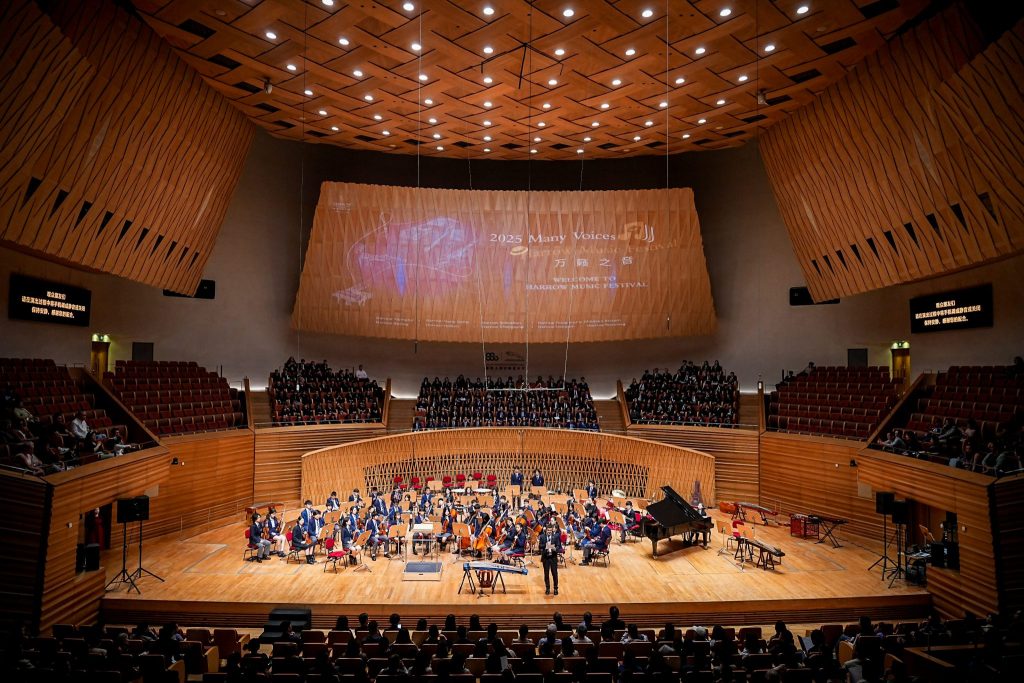
At AISL Harrow Haikou, our commitment to bilingual education is both philosophical and practical. We want our students to thrive in any cultural or linguistic context, whether studying abroad or contributing to their home country. This is why we sought and achieved accreditation from the Council of British International Schools (COBIS) in March 2025. We believe that bilingualism offers the best of both worlds, combining the cultural and academic strengths of local systems with the opportunities and perspectives of an international education. The result is young people who are linguistically skilled and culturally confident, ready for a life of leadership and service in our globalised world.
Here at COBIS we are proud to work with colleagues such as Oliver and with the growing number of schools developing bilingual models for learning, teaching and curriculum delivery. In conclusion, there are clearly challenges, especially around recruitment and training of qualified educators committed to bilingual learning. However, the benefits to students, their families, the schools, and perhaps idealistically, for international understanding and cooperation are clear. We look forward to working with many more such schools in the years ahead.
Language Learning that may be of interest:
Get a special discount by quoting code AISLMALL during CHECKOUT.
Books and E-books – Shanghai Book Traders
Shanghai Book Traders was established in 1950 and has a development history of over 70 years. It is a state-owned book import and export company with its headquarters located at Fuzhou Road, Huangpu District, Shanghai. It owns its own stores and warehousing centers and has branches overseas as well as several distribution centers in Asia, Europe and America. The company has established partnerships with thousands of publishing houses at home and abroad. Its business scope includes book retail, wholesale, import and export of books and periodicals, holding various book exhibitions at home and abroad, copyright trading, agency import and export, etc. Among them, the book import and export business holds over 70% of the market share in the East China region and has established business relations with most foreign-related schools and institutions in the region.
Language Learning – Speechsquare

Speechsquare by Melyngo Technology PTE LTD is an AI Speech Analytics company. They optimise the tutoring and assessment of oral skills. Their proprietary AI allows granular analysis of speech up to the phoneme, enabling instant visual and audio feedback for the learner and powerful analysis tools for language specialists. Speechsquare is available in 7 languages: English, Chinese, Korean, Japanese, Spanish, French, and German.
Leveled Reading Platform for Pre-K to Grade 8 – Chinese 1-2-Tree
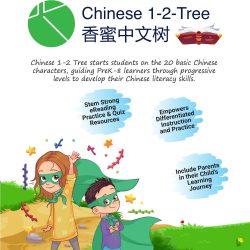
Chinese 1-2-Tree is a unique leveled reading interactive learning platform designed to provide progressive leveled reading starting with 20 basic characters. Chinese 1-2-Tree provides teachers with a scaffolded leveled reading program that uses accessible digital technology to improve teaching effectiveness, save time, and reduce students’ workload. Chinese 1-2-Tree offers literacy essentials for every PreK-8 Chinese classroom. They offer a complete solution for reading instruction and student practice, perfect for use in class and at home.
Online English Classes for Kids – Novakid
Novakid is Europe’s #1 online English school for kids aged 4-12, trusted by families worldwide. With certified native-speaking teachers, it offers interactive lessons that make learning fun and effective. Using games, activities, and full-language immersion, Novakid helps kids build confidence and English fluency. Its CEFR-based curriculum ensures real progress, while parents appreciate the blend of high-quality education and enjoyable experiences that prepare children for future success.