Bilingual education programmes have been flourishing around the world. They can be defined as programmes or approaches that combine curriculum content and additional language (hereafter L2) learning (Banegas & Zappa-Hollman, 2024). These programmes may appear under different labels (e.g., Content and Language Integrated Learning, English Medium Instruction) in different educational contexts. This article focuses on those programmes that are content-oriented, usually manifested by the fact that teachers are content specialists and the curriculum and assessment are dominated by content learning outcomes.
This resonates also with the programmes implemented in many secondary schools in Hong Kong and international schools in Asia. In these programmes, one intriguing and unresolved issue is that students’ content knowledge is assessed through their L2, and their results are compared with their counterparts taking the same assessment in their first language (L1). How can the assessment process be valid and fair? This article seeks to tease out the complexities involved in assessment in bilingual education and some possible solutions.
Assessments in Bilingual Education: Complexities and Solutions
Assessing students’ academic achievement in their L2, which is often their less proficient language, has long been controversial, with several issues worth highlighting. First, as aforementioned, bilingual education programmes usually focus on content learning outcomes. However, content and language (no matter L1 or L2) are inseparable when construing meanings or content.
It follows that it is very difficult to isolate students’ content learning from their language ability. Some may even argue that language, in terms of academic literacies comprising subject-specific terms, typical academic functions, sentence patterns and genres, should indeed be part of the assessment, as they are discipline-specific ways to express content knowledge (Sato, 2024). When students take the assessment in their L2 in bilingual education programmes, the mediating effect of their L2 proficiency on their performance will be more significant, in the sense that they may encounter difficulties in understanding the questions and/or demonstrating their content knowledge in their L2 (Lo et al., 2023).
Second, teachers in bilingual education often find it challenging to assess their students. Many of these teachers tend to put more emphasis on content when designing assessment tasks and marking rubrics, but their marking is indeed affected by students’ L2 proficiency (Honig, 2010). They also struggle when selecting appropriate assessment tools for bilingual students. Teachers often stick to conventional assessment tools (typically written tests), even though they may be aware that other assessment tools (e.g., oral presentations) can better capture student learning in bilingual education (Otto & Estrada, 2019).
Such inconsistencies between teachers’ perceptions and practices when assessing bilingual students are often attributed to lack of assessment guidelines and professional training. As effective assessment plays a significant role in teaching and learning, these issues need to be addressed.

Potential Solutions
First, teachers should be aware of their assessment objectives, which should align with the learning objectives and instruction. This alignment is essential for effective teaching and learning, and it is especially important for bilingual education. Teachers need to consider whether they are assessing students’ content and/or language learning outcomes. As discussed, teachers in bilingual education tend to focus on content learning, but they should not overlook the importance of academic literacies and the mediating role of L2 on students’ performance in assessment.
Second, once teachers have clear assessment objectives, they will be in a better position to determine how they will assess their students. The “how” question can be addressed by different assessment formats, including ongoing, classroom-based assessment, where teachers can provide timely feedback to facilitate students’ learning (deBoer & Leontjev, 2022), or summative assessment that evaluates students’ learning outcomes at a particular point in time.
Assessment Literacy
How to assess also concerns different types of assessment questions, with different levels of cognitive and linguistic demands. For instance, multiple-choice questions can impose different levels of cognitive demands (e.g., recall, application, analysis), but their linguistic demands are low, in the sense that students only need to understand the questions and options, without producing any language; scenario-based structured questions expect students to understand the scenario and questions, and to answer the questions with sentences or short paragraphs; essay questions are usually the most demanding in both cognitive and linguistic aspects, as students have to demonstrate in-depth content knowledge and higher-order thinking skills with a structured text.
Teachers are strongly advised to include different types of questions in the same assessment task so that they can better diagnose students’ learning progress and difficulties in content and language aspects. Further, teachers can adopt various assessment tools. While paper-based assessments are still dominant, teachers can consider using other assessment tasks such as oral presentations, poster creation, portfolio, project, hands-on demonstration, etc. These alternative assessment tools may help reduce the linguistic demands on students. However, these assessment tasks require other skills (e.g., speaking and presentation skills, digital literacies) and teachers may need to provide support for their students.
Multimodal Elements in Assessment
Third, accommodation could be provided to help students overcome potential language barriers in assessment. For instance, teachers may provide bilingual versions of the assessment and oral or written translation of the questions to facilitate students’ comprehension of the questions and hence their academic performance (Shohamy et al., 2022). Teachers may allow students to answer the questions with the target language (L2) or their L1 if necessary, so that they can express their content knowledge more effectively (Gorter & Cenoz, 2017).
In contexts where bilingual or translanguaging assessments cannot be implemented (e.g., owing to the requirement of high-stakes examinations, very diverse students’ L1 backgrounds), teachers can consider utilising multimodal elements such as pictures, photographs, tables and graphs that can present the assessment questions in a more accessible way. At the same time, teachers can ask students to demonstrate their content knowledge through non-linguistic modes like plotting graphs and drawing pictures. Incorporating multimodal elements can help students overcome the potential language barriers in content assessments (Grapin & Ascenzi-Moreno, 2024).
Looking Ahead
This article has unpacked some issues concerning assessment in bilingual education programmes, largely caused by the fact that students’ content knowledge is assessed through their less proficient L2. It is then essential for teachers in bilingual education programmes to understand what they want to assess and what assessment strategies they are going to adopt.
In other words, they should develop their assessment literacy (Lo & Leung, 2020), so that they can design and implement more valid and equitable assessments for students. In the era of GenAI, it is expected that some assessment issues in bilingual education programmes may become more complicated. How teachers can better assess and support their students definitely warrants more classroom-based empirical research.
Language Learning that may be of interest:
Get a special discount by quoting code AISLMALL during CHECKOUT.
Books and E-books – Shanghai Book Traders
Shanghai Book Traders was established in 1950 and has a development history of over 70 years. It is a state-owned book import and export company with its headquarters located at Fuzhou Road, Huangpu District, Shanghai. It owns its own stores and warehousing centers and has branches overseas as well as several distribution centers in Asia, Europe and America. The company has established partnerships with thousands of publishing houses at home and abroad. Its business scope includes book retail, wholesale, import and export of books and periodicals, holding various book exhibitions at home and abroad, copyright trading, agency import and export, etc. Among them, the book import and export business holds over 70% of the market share in the East China region and has established business relations with most foreign-related schools and institutions in the region.
Language Learning – Speechsquare

Speechsquare by Melyngo Technology PTE LTD is an AI Speech Analytics company. They optimise the tutoring and assessment of oral skills. Their proprietary AI allows granular analysis of speech up to the phoneme, enabling instant visual and audio feedback for the learner and powerful analysis tools for language specialists. Speechsquare is available in 7 languages: English, Chinese, Korean, Japanese, Spanish, French, and German.
Leveled Reading Platform for Pre-K to Grade 8 – Chinese 1-2-Tree
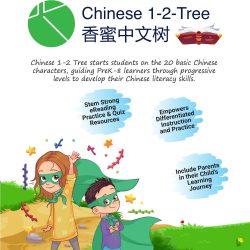
Chinese 1-2-Tree is a unique leveled reading interactive learning platform designed to provide progressive leveled reading starting with 20 basic characters. Chinese 1-2-Tree provides teachers with a scaffolded leveled reading program that uses accessible digital technology to improve teaching effectiveness, save time, and reduce students’ workload. Chinese 1-2-Tree offers literacy essentials for every PreK-8 Chinese classroom. They offer a complete solution for reading instruction and student practice, perfect for use in class and at home.
Online English Classes for Kids – Novakid
Novakid is Europe’s #1 online English school for kids aged 4-12, trusted by families worldwide. With certified native-speaking teachers, it offers interactive lessons that make learning fun and effective. Using games, activities, and full-language immersion, Novakid helps kids build confidence and English fluency. Its CEFR-based curriculum ensures real progress, while parents appreciate the blend of high-quality education and enjoyable experiences that prepare children for future success.